Support our educational content for free when you purchase through links on our site. Learn more
🔮 Future of Virtual Fitness Challenges (2026)

The future of virtual fitness challenges is flexible, personalized, social, and increasingly immersive. The best events will combine wearable tracking, AI-powered guidance, inclusive activity options, interactive stories, and real human encouragement, allowing you to join virtual walkathons worldwide without traveling to a starting line.
Picture this: you finish a rainy-day treadmill walk, tap “sync,” and watch your progress move from Kyoto to Yellowstone on a digital route. A friend in another country reaches the same milestone, your team receives a cheerful update, and a charity or environmental project benefits from the completed challenge. The walk was local; the experience was global.
Virtual fitness has already moved beyond basic step counts. Platforms such as The Conqueror Challenges show how maps, themed adventures, wearable integrations, digital milestones, and physical rewards can turn routine movement into a story you want to continue.
But the smartest future is not necessarily the one with the most gadgets. It is the one that makes exercise more accessible, motivating, private, and realistic for everyday life. Will AI build your plan? Probably. Will a headset take you around the world from your living room? Increasingly. Will it replace a good coach, a supportive friend, or your own judgment? Not a chance.
Key Takeaways
- Virtual fitness challenges are evolving beyond step counting into personalized, story-driven, social, and immersive movement experiences.
- AI and wearable technology will help tailor goals, track progress, suggest recovery, and connect activity across platforms such as Apple Health, Fitbit, Garmin, and Strava.
- Inclusive activity rules matter: future challenges should welcome walking, running, cycling, swimming, wheelchair movement, strength training, and other accessible options.
- Social accountability beats pressure. Small teams, family groups, charity goals, and supportive communities can make participation more sustainable than speed-based leaderboards.
- Privacy must keep pace with innovation. Review location tracking, health-data permissions, public profiles, third-party sharing, and account deletion policies before joining.
- Virtual challenges will complement—not replace—in-person events, offering flexible participation while traditional events continue to provide atmosphere and face-to-face connection.
- The best challenge is the one you can safely complete and enjoy, with realistic pacing, rest options, meaningful milestones, and rewards that celebrate progress rather than perfection.
Table of Contents
- ⚡ Quick Tips and Facts About the Future of Virtual Fitness Challenges
- 🌐 The Evolution of Virtual Fitness Challenges: From Step Counts to Immersive Experiences
- 🔮 What Is the Future of Virtual Fitness Challenges?
- How Virtual Fitness Challenges Are Changing Exercise Motivation
- The Rise of Digital Walking Challenges, Online Races, and Remote Wellness Programs
- 🚀 12 Trends Shaping the Next Generation of Virtual Fitness Challenges
- 1. Artificial Intelligence–Powered Coaching and Personalization
- 2. Wearable Fitness Tracker and Health App Integration
- 3. Augmented Reality and Virtual Reality Fitness Adventures
- 4. Social Fitness Communities and Real-Time Accountability
- 5. Gamification, Digital Rewards, and Achievement Systems
- 6. Adaptive Challenges for Every Fitness Level
- 7. Corporate Wellness and Employee Engagement Platforms
- 8. Inclusive Design for Accessibility and Diverse Abilities
- 9. Mental Health, Stress Relief, and Holistic Well-Being Goals
- 10. Sustainable Fitness Challenges and Eco-Friendly Rewards
- 11. Blockchain-Based Badges, Digital Collectibles, and Verified Achievements
- 12. Privacy-First Health Data and Trustworthy Fitness Technology
- 📱 How Future Virtual Fitness Challenges Will Work
- Setting a Goal, Choosing a Challenge, and Building a Personal Plan
- Logging Walking, Running, Cycling, Swimming, Hiking, and Other Activities
- Syncing Exercise Data From Apple Health, Fitbit, Garmin, Strava, and Wear OS
- Tracking Distance, Time, Steps, Calories, and Active Minutes
- Completing Scenic Routes Through Interactive Maps and Digital Storytelling
- Managing Multiple Challenges, Teams, and Join Codes
- Finishing a Challenge and Receiving Digital or Physical Rewards
- 🏆 The Best Types of Virtual Fitness Challenges for 2026 and Beyond
- Virtual Walking and Step Challenges
- Virtual Running Challenges and Online Race Experiences
- Virtual Cycling, Hiking, and Endurance Challenges
- Workplace Fitness Competitions and Team Wellness Challenges
- Charity-Based Fitness Challenges and Fundraising Events
- Family-Friendly Fitness Challenges for All Ages
- School, University, and Community Movement Challenges
- Personalized Weight-Loss, Strength, and Habit-Building Challenges
- 🎮 Why Gamification Makes Digital Fitness More Addictive in a Good Way
- Progress Bars, Streaks, Milestones, and Virtual Badges
- Leaderboards Versus Personal Bests: Which Motivates You More?
- Story-Driven Adventures Inspired by Travel, History, and Pop Culture
- How Rewards, Competition, and Collaboration Affect Motivation
- 🤝 Social Connection and Accountability in Remote Fitness
- How Teams, Families, and Online Communities Work
- Creating Inclusive Virtual Fitness Groups Across Countries
- Live Events, Group Walks, Challenges, and Virtual Meetups
- Preventing Toxic Competition and Fitness Comparison
- 🧠 Artificial Intelligence, Wearables, and the Personalization of Exercise
- AI-Generated Training Plans and Adaptive Goals
- Predictive Feedback for Recovery, Fatigue, and Injury Risk
- Smartwatch Sensors, Biometrics, and Real-Time Coaching
- The Limits of AI Fitness Advice and the Role of Qualified Professionals
- 🥽 Virtual Reality, Augmented Reality, and Immersive Fitness Experiences
- How VR Fitness Games Could Transform Home Workouts
- AR Walking Routes, Digital Scavenger Hunts, and Location-Based Play
- Safety, Motion Sickness, Privacy, and Accessibility Considerations
- 🏢 The Future of Workplace and Corporate Virtual Fitness Challenges
- Why Employers Use Remote Wellness Programs
- Measuring Participation, Engagement, and Health Outcomes
- Designing Fair Challenges for Hybrid and Distributed Teams
- Avoiding Workplace Pressure, Surveillance, and Coercion
- ♿ Making Virtual Fitness Challenges More Inclusive and Accessible
- Low-Impact Options for Beginners, Older Adults, and People With Disabilities
- Alternative Activity Equivalencies Beyond Steps and Distance
- Accessible Apps, Captions, Screen Readers, and Flexible Scheduling
- Culturally Inclusive Goals, Routes, Rewards, and Community Features
- 🔐 Privacy, Safety, and Ethics in Connected Fitness
- Who Owns Your Fitness and Health Data?
- Location Tracking, Data Sharing, and Account Security
- Health Claims, Personalized Recommendations, and Medical Boundaries
- How to Choose a Trustworthy Virtual Fitness Platform
- 📊 How Effective Are Virtual Fitness Challenges?
- Benefits for Physical Activity, Cardiovascular Health, and Daily Movement
- Effects on Habit Formation, Motivation, and Exercise Adherence
- Potential Drawbacks: Burnout, Overtraining, Cheating, and Screen Fatigue
- What Research Says About Digital Health Interventions
- ✅ How to Choose the Right Future-Ready Fitness Challenge
- Match the Challenge to Your Fitness Goal and Schedule
- Check Activity Options, Tracking Accuracy, and Device Compatibility
- Compare Social Features, Coaching, Rewards, and Accessibility
- Review Data Privacy, Refund Policies, and Customer Support
- 🛠️ How to Design a Successful Virtual Fitness Challenge
- Define the Purpose, Audience, Duration, and Success Metrics
- Build Fair Rules for Different Fitness Levels and Activities
- Create Engaging Themes, Stories, Rewards, and Team Mechanics
- Use Reminders, Progress Updates, and Community Check-Ins
- Evaluate Results and Improve the Next Challenge
- 👟 Practical Tips for Winning Without Wrecking Your Knes
- Start With a Realistic Goal and Gradual Progression
- Use Rest Days, Cross-Training, and Recovery Strategies
- Stay Motivated When Your Progress Bar Looks Stubborn
- Recognize Warning Signs and Know When to Seek Medical Advice
- 💡 Common Questions About the Future of Virtual Fitness Challenges
- Will AI Replace Personal Trainers in Virtual Fitness?
- Will Virtual Fitness Challenges Become More Immersive Than In-Person Events?
- Can Virtual Challenges Count Any Type of Exercise?
- How Long Will It Take to Complete a Virtual Challenge?
- Can You Join Multiple Virtual Fitness Challenges at Once?
- Will Virtual Fitness Challenges Be Available Worldwide?
- Are Virtual Fitness Challenges Worth Joining?
- 🌟 The Walkathon Virtual™ Vision for the Future of Digital Movement
- 🏁 Conclusion
- 🔗 Recommended Links
- 📚 Reference Links
Quick Tips and Facts About the Future of Virtual Fitness Challenges
If you want a simple answer first: the future of virtual fitness challenges is flexible, social, personalized, and increasingly immersive. You may walk around your neighborhood, pedal an indoor bike, or complete a low-impact routine at home while your progress advances along a route thousands of miles away.
That is the appeal of Walkathon Virtual™: join virtual walkathons worldwide without needing to travel to a starting line.
Quick facts at a glance
| Question | Practical answer |
|---|---|
| What counts? | Walking, running, cycling, hiking, treadmill exercise, and potentially other approved activities, depending on the event |
| Do I need a smartwatch? | ❌ No. Many challenges support manual logging; wearables simply make tracking easier |
| Can beginners participate? | ✅ Yes. Choose a distance, pace, and deadline that fit your current ability |
| Are challenges competitive? | They can be, but personal milestones and team completion are often more sustainable than rankings |
| What will change next? | AI coaching, better wearable integration, immersive maps, adaptive goals, accessibility tools, and richer online communities |
| What is the biggest risk? | Turning helpful data into pressure, comparison, or unnecessary health surveillance |
| What makes a challenge work? | A clear goal, flexible activity rules, visible progress, social support, and a satisfying finish |
The World Health Organization recommends adults accumulate 150–300 minutes of moderate-intensity physical activity weekly, or an equivalent amount of vigorous activity. A virtual challenge does not magically make exercise effective, but it can make regular movement easier to schedule and more rewarding. See the WHO physical activity guidelines.
Our trainers’ five practical predictions
- Virtual events will become more activity-inclusive. Steps alone do not tell the whole story. Cycling, swimming, chair-based exercise, strength training, and household movement deserve sensible pathways into participation.
- Personal targets will matter more than universal leaderboards. Your best challenge may be “move four days this week,” not “beat the fastest person in the office.”
- Storytelling will keep people coming back. The Conqueror’s route-based model shows how postcards, milestones, destinations, and themed adventures can turn a walk into a continuing narrative.
- Human support will remain essential. AI can calculate, remind, and personalize. A coach, friend, or team member can still say, “You’ve got this,” at exactly the right moment.
- Privacy will become a deciding factor. Before connecting Apple Health, Fitbit, Garmin, or another service, check what data an app collects and why.
So, is this merely step counting with better graphics? Not quite. The more interesting question is how virtual fitness challenges will combine movement, education, entertainment, and community without making exercise feel like another job. We’ll return to that tension when we examine the technology and the trade-offs.
The Evolution of Virtual Fitness Challenges: From Step Counts to Immersive Experiences
Virtual fitness challenges began with a straightforward proposition: record movement, accumulate distance, and reach a shared goal from anywhere. Early formats often relied on spreadsheets, email updates, or simple pedometer totals. Today, an app can transform those same miles into a route through Kyoto, Yellowstone, the English Channel, or a fictional universe.
The difference is not just cosmetic. The experience has shifted from measurement to meaning.
From remote participation to digital adventure
A traditional race usually gives participants:
- A fixed location
- A fixed date
- A shared start and finish
- A bib, timing system, and in-person atmosphere
A virtual event changes the formula:
- Location becomes flexible
- The challenge window can last days or weeks
- Participants progress independently or in teams
- Distance can be recorded through apps, watches, or manual entry
- Motivation comes from progress, community, education, stories, and rewards
The University of Liverpool’s “Run the Length of the Future Circular Collider” illustrates this educational direction. Participants were invited to walk or run 91 kilometres, the proposed circumference of the Future Circular Collider, during a defined challenge period. The University of Liverpool event description connected physical activity with particle physics, showing that a virtual challenge can teach as well as motivate.
The four phases of virtual fitness
| Phase | Main experience | Typical tools | Main limitation |
|---|---|---|---|
| 1. Manual distance logging | Enter miles or kilometres yourself | Forms, spreadsheets, basic event portals | Tedious and vulnerable to errors |
| 2. App-based tracking | Log progress inside a dedicated platform | Smartphone GPS, activity dashboards | Requires regular engagement |
| 3. Connected fitness ecosystems | Sync data from wearables and health apps | Apple Health, Fitbit, Garmin, Strava | Privacy and compatibility concerns |
| 4. Adaptive immersive challenges | Receive personalized goals, story content, social prompts, and feedback | AI, AR/VR, smart equipment, live communities | Higher complexity and digital access barriers |
The Conqueror app sits firmly in the third and fourth phases. Its public materials describe more than 80 challenges, route-based progress, activity syncing, collectible content, environmental contributions, and physical medals. The company also reports more than 1 million Conquerors globally and an 87.9% success rate. Those figures are brand-reported rather than independently audited, so we treat them as useful context, not clinical evidence.
Why storytelling works
A distance such as 100 kilometres can feel abstract. A route from one memorable location to another gives the distance a mental shape.
Our clients often say, “I only need to get another postcard,” rather than, “I need to complete another 2.5 kilometres.” That small change matters. It moves attention from effort alone to curiosity and completion.
The Conqueror’s user examples reinforce that idea:
- Nika M. connected five medals with more than a year without smoking.
- Lala I. used a treadmill and exercise bike because disability limited travel.
- Salvador M. described a Scoby-Doo challenge as a family-friendly way to make movement fun.
- Seth M. said displaying medals helped him recognize his accomplishments.
These testimonials are personal reports, not controlled studies. Still, they reveal what many successful challenges now include: flexibility, emotional meaning, family participation, home-based options, and a physical reminder of progress.
The next shift: from “How far?” to “How well does this fit my life?”
The future will likely judge a challenge by more than distance. Participants will ask:
- Can I use a wheelchair, treadmill, hand cycle, or indoor bike?
- Can I pause during illness, caregiving, travel, or a busy work period?
- Can I participate without sharing my exact location?
- Can my team include different ages and ability levels?
- Does the app understand that a gentle walk may be a major achievement for me?
That is why our Accessibility in Walkathons resources matter. A virtual format is only genuinely accessible when the rules, interface, tracking choices, and social culture are accessible too.
What Is the Future of Virtual Fitness Challenges?
The future is not one single app or device. It is an ecosystem in which movement data, personal goals, digital stories, social encouragement, and real-world rewards work together.
The most promising model looks something like this:
- You choose a goal based on health, enjoyment, charity, travel, or community.
- The platform suggests a challenge that fits your schedule and ability.
- You select how to record activity: wearable sync, phone tracking, or manual entry.
- The system adapts reminders and milestones to your actual behavior.
- You see progress through maps, stories, educational content, or virtual scenery.
- Friends, family, colleagues, or a global community provide accountability.
- You finish with a meaningful reward, reflection, charitable contribution, or next-step recommendation.
How Virtual Fitness Challenges Are Changing Exercise Motivation
Traditional motivation often depends on willpower. Unfortunately, willpower is a fickle roommate. It disappears when sleep is poor, work runs late, or the weather looks personally offended.
Virtual challenges add several motivation layers:
| Motivation layer | Example | Why it helps |
|---|---|---|
| Goal | Complete a route or reach a weekly activity target | Gives movement direction |
| Feedback | Progress bar, map, milestone, or notification | Makes invisible progress visible |
| Story | Unlock a postcard or educational fact | Adds curiosity |
| Social support | Team updates or community comments | Reduces isolation |
| Reward | Badge, certificate, medal, or donation | Creates a satisfying finish |
| Identity | “I’m someone who completes challenges” | Supports long-term habit formation |
Research on digital behavior-change interventions is mixed, but a systematic review in the Journal of Medical Internet Research found that digital interventions can support physical activity, especially when they include feedback, self-monitoring, and behavioral prompts. Effects vary by design and participant, so no app replaces a sensible plan.
The first video’s smart-gym perspective
The featured video presents a useful perspective: the future of fitness may blend smart gyms, wearable data, virtual training, AI feedback, immersive environments, and social challenges rather than forcing people to choose between physical and digital exercise.
We agree with the central idea, with one qualification. Technology should serve the participant, not turn every walk into a biometric audit. A polished dashboard is helpful; a stressful stream of alerts is not. The best platforms will pair data with human encouragement, clear consent, and the option to participate simply.
The Rise of Digital Walking Challenges, Online Races, and Remote Wellness Programs
Virtual walking challenges are especially well suited to broad participation because walking requires relatively little equipment and can be adapted to many environments.
They can support:
- Neighborhood walks
- Treadmill sessions
- Mall walking
- Hiking trails
- Walking meetings
- Dog walks
- Accessible indoor routes
- Short activity breaks across the day
The CDC describes walking as a practical way to increase physical activity and provides guidance through its walking and physical activity resources. For general health advice, people with chronic conditions, pain, or symptoms should consult a qualified clinician.
Remote wellness programs are also expanding in workplaces, schools, charities, and community groups. Our Event Promotion category covers planning considerations such as clear messaging, registration pathways, progress updates, and participant reminders.
12 Trends Shaping the Next Generation of Virtual Fitness Challenges
The next wave will not be powered by one dazzling gadget. It will be built from several improvements working together. Here are the twelve trends we think deserve the closest attention.
1. Artificial Intelligence–Powered Coaching and Personalization
AI can analyze patterns such as:
- Typical activity days
- Preferred exercise types
- Missed sessions
- Completion speed
- Self-reported energy
- Training load
- Recent progress
It can then suggest a shorter session, a rest day, or a more realistic deadline.
The benefit: less guesswork.
The concern: AI recommendations are only as reliable as their data and design. An algorithm should not diagnose injury, override medical advice, or shame someone for missing a day.
A responsible AI coach should:
- Explain why it made a recommendation
- Allow users to correct inaccurate data
- Offer opt-outs
- Avoid medical claims
- Refer users to healthcare professionals when symptoms appear
- Separate encouragement from surveillance
2. Wearable Fitness Tracker and Health App Integration
Connected devices can reduce the friction of logging. Apple Watch, Fitbit, Garmin, Samsung Galaxy Watch, Polar, and compatible smartphone platforms can record steps, heart rate, distance, workouts, and active minutes.
The Apple HealthKit documentation and Google Health Connect information show how health platforms can act as data hubs. However, integration is not identical across apps.
What to check before connecting a device
- Which activities synchronize?
- Is distance imported automatically or manually reviewed?
- Are duplicate activities filtered?
- Does the app use GPS continuously?
- Can you edit incorrect entries?
- What happens when a watch battery dies?
- Is your data deleted when you close your account?
A synced device is convenient, but manual entry remains valuable for inclusion. Not everyone owns a smartwatch, and not every activity produces clean sensor data.
3. Augmented Reality and Virtual Reality Fitness Adventures
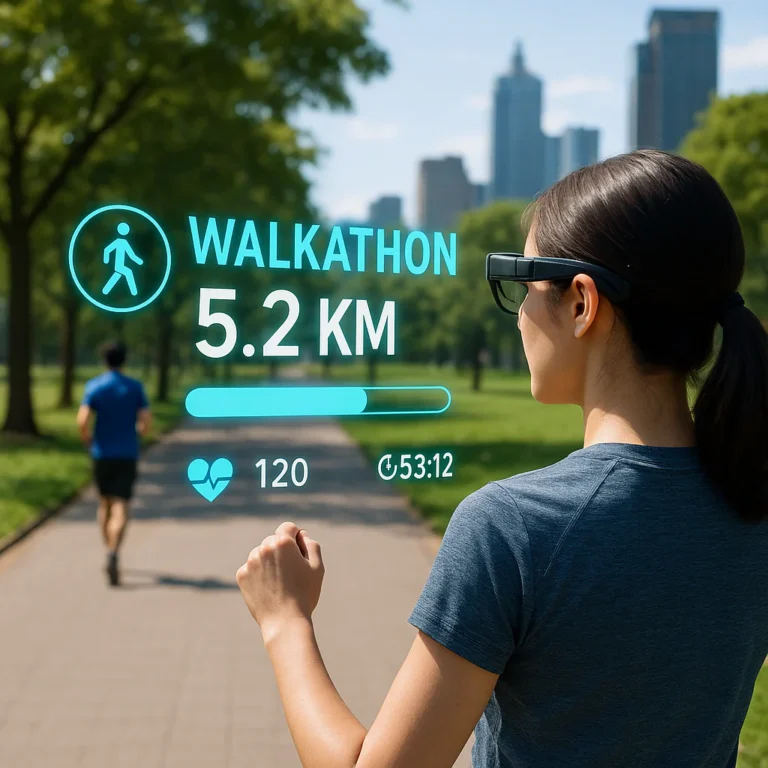
AR can overlay digital information onto a real walking route. VR can place users inside a simulated environment, such as a mountain trail, museum, or space station.
Possible future experiences include:
- Following virtual signposts during a neighborhood walk
- Collecting digital objects along an accessible route
- Exploring a destination while using a treadmill
- Joining a live group walk in a shared virtual environment
- Learning historical or scientific facts at route milestones
The barriers are equally real:
- Headset cost and availability
- Motion sickness
- Safety while walking outdoors
- Visual, hearing, or mobility accessibility
- Privacy around location and camera data
- Screen fatigue
Immersion should be optional. A beautiful map should enhance a walk, not become a required obstacle course.
4. Social Fitness Communities and Real-Time Accountability
A community can transform a solitary activity into a shared ritual. Future platforms may offer:
- Small accountability circles
- Live group events
- Team missions
- Private family spaces
- Coach-led check-ins
- Peer encouragement
- Language-specific groups
- Moderated discussion areas
The social design matters. Public leaderboards can energize some people and discourage others. We recommend platforms that offer multiple ways to compare progress, including personal bests, team completion, consistency, and participation.
The American College of Sports Medicine emphasizes the value of regular physical activity and professional guidance. Social motivation can support that activity, but it should not pressure users into unsafe training.
5. Gamification, Digital Rewards, and Achievement Systems
Gamification is more than confetti. Useful elements include:
- Progress bars
- Streaks
- Milestones
- Badges
- Collectibles
- Route postcards
- Team goals
- Surprise content
- Finisher certificates
- Medals or merchandise
The trick is to reward behaviors people can control, such as showing up, completing a planned session, or taking a recovery day, rather than rewarding only speed.
✅ Better: “You completed four movement sessions this week.”
❌ Less helpful: “You ranked 8,431st, so try harder.”
6. Adaptive Challenges for Every Fitness Level
A fixed 100-kilometre route can be inspiring for one person and absurdly intimidating for another. Adaptive challenges may change:
- Distance targets
- Completion windows
- Weekly pacing
- Activity equivalencies
- Rest allowances
- Reminder frequency
- Route difficulty
- Team contribution expectations
A challenge can preserve a shared theme while giving each participant a sensible individual pathway.
For example:
| Participant | Shared event | Personalized target |
|---|---|---|
| New walker | Global city route | 10 minutes, four days weekly |
| Experienced walker | Same route | 25 kilometres per week |
| Cyclist | Same route | Approved distance conversion |
| Wheelchair user | Same route | Rolling distance or time-based goal |
| Busy parent | Same route | Flexible completion window |
| Older adult | Same route | Short sessions with planned recovery |
7. Corporate Wellness and Employee Engagement Platforms
Employers may use virtual challenges to encourage movement across remote, hybrid, and office-based teams. Effective programs should focus on participation, not surveillance.
Good workplace design includes:
- Voluntary enrollment
- Anonymous or aggregate reporting
- Multiple activity options
- Flexible schedules
- No penalty for nonparticipation
- Accessible alternatives
- Clear data policies
- Rewards that do not embarrass or exclude
Our Fundraising Ideas category also explores how workplace movement can connect to charitable causes. A team may be more enthusiastic about walking toward clean-water funding or local community support than chasing a generic leaderboard.
8. Inclusive Design for Accessibility and Diverse Abilities
Accessibility is not a decorative feature added at the end. It affects:
- Registration
- Goal selection
- Activity conversion
- App navigation
- Notifications
- Content formats
- Medal eligibility
- Team communication
- Customer support
The U.S. Access Board provides accessibility standards and guidance relevant to digital and physical environments. Platforms should also test their products with disabled participants rather than assuming a checklist captures lived experience.
9. Mental Health, Stress Relief, and Holistic Well-Being Goals
Future challenges will likely measure more than steps. Participants may choose goals involving:
- Outdoor time
- Mood-supporting movement
- Sleep routines
- Stretching
- Breathing practices
- Social connection
- Recovery
- Nature exposure
Physical activity can support mental health, but apps should avoid implying that exercise cures depression, anxiety, or other conditions. The National Institute of Mental Health offers reliable mental health information and treatment guidance.
10. Sustainable Fitness Challenges and Eco-Friendly Rewards
Some virtual challenges connect completed activity to environmental action, such as tree planting or plastic removal. The Conqueror states that completed challenges can support planting five trees or removing 50 plastic items, depending on the challenge.
That is a compelling model, but transparency matters. Participants should be able to see:
- The environmental partner
- The type of action funded
- When the action occurs
- How completion is verified
- Whether the contribution is guaranteed or conditional
A digital medal made from questionable materials would be a rather awkward symbol of sustainability. Future organizers should consider recycled materials, minimal packaging, digital certificates, and local fulfillment.
11. Blockchain-Based Badges, Digital Collectibles, and Verified Achievements
Blockchain may enable portable achievement records, but it is not automatically useful. Most participants simply want to know they completed a challenge.
Potential advantages:
- Verifiable completion records
- Transferable digital badges
- Event history across platforms
- Tamper-resistant certificates
Potential drawbacks:
- Energy use, depending on the system
- Complexity
- Wallet security
- Privacy concerns
- Speculative marketing
- Little practical value for everyday exercisers
Our recommendation is simple: use blockchain only when it solves a real problem. A normal certificate is still perfectly capable of making someone proud.
12. Privacy-First Health Data and Trustworthy Fitness Technology
The future of connected fitness depends on trust. Apps may process:
- Location
- Exercise history
- Heart rate
- Weight
- Contacts
- Device identifiers
- User-generated content
- Payment details
- Health and fitness data
The Federal Trade Commission’s health privacy guidance explains why organizations should handle health-related information carefully. App-store privacy labels are useful but not a complete independent audit.
Before joining, ask:
- What data is required?
- What data is optional?
- Can I participate without location tracking?
- Who receives my data?
- How long is it retained?
- Can I export or delete it?
- Are public profiles enabled by default?
- Does the platform sell or share data for advertising?
How Future Virtual Fitness Challenges Will Work
The future participant journey will probably feel less like filling out a form and more like entering a flexible digital event. Still, the underlying steps remain practical.
Setting a Goal, Choosing a Challenge, and Building a Personal Plan
Start with the goal, not the medal.
Step 1: Identify the reason you want to participate
Your reason might be:
- Improve daily activity
- Prepare for an in-person event
- Support a charity
- Connect with friends
- Explore a destination virtually
- Build consistency
- Return to exercise after a break
- Celebrate a personal milestone
Step 2: Choose a measurable target
Examples:
- Move for 20 minutes on five days each week
- Walk 50 kilometres over six weeks
- Complete three activity sessions weekly
- Join a team and contribute a flexible amount
- Accumulate a set number of active minutes
Step 3: Match the challenge to your calendar
A route that looks exciting may become a burden if its deadline clashes with travel, exams, caregiving, or work deadlines. Build in recovery and missed-day flexibility.
Step 4: Decide how you will track
Choose among:
- Smartphone tracking
- Smartwatch or fitness band
- Treadmill display
- Indoor cycling app
- Manual logging
- Approved activity conversion
Step 5: Plan your fallback
Ask: “What will I do if rain, pain, illness, or a family emergency interrupts my plan?”
A good answer may be a 10-minute indoor walk, gentle mobility, or a pause. A flexible plan survives real life better than a perfect plan that collapses on Tuesday.
Logging Walking, Running, Cycling, Swimming, Hiking, and Other Activities
Activity rules differ, so read them before starting. Some challenges count only distance-based activities; others allow time-based exercise or conversions.
A robust future platform should explain:
- Which activities qualify
- How each activity converts
- Whether outdoor and indoor activity are treated equally
- Whether strength sessions count
- Whether household chores count
- How mixed activities are combined
- What evidence, if any, is required
The Conqueror’s public descriptions are notably broad, mentioning walking, running, cycling, swimming, weightlifting, dog walking, household chores, and other activities. That breadth can make participation more inclusive, but users should always verify current rules inside the selected challenge.
Syncing Exercise Data From Apple Health, Fitbit, Garmin, Strava, and Wear OS
A typical connection process looks like this:
- Open the challenge app.
- Go to settings or integrations.
- Select the health platform or device.
- Review requested permissions.
- Allow only the data categories needed.
- Complete a short test activity.
- Confirm that the distance or duration appears correctly.
- Check duplicate entries.
- Review battery and location settings.
Common problems include:
- Permissions not fully enabled
- Activities recorded under the wrong account
- Duplicate imports
- GPS drift
- Delayed synchronization
- Unit mismatches between miles and kilometres
- A device recording steps but not a workout
- Indoor workouts lacking GPS distance
If the app supports manual correction, use it promptly and save screenshots of important records. A challenge should not become detective work worthy of a crime drama.
Tracking Distance, Time, Steps, Calories, and Active Minutes
Each metric answers a different question.
| Metric | Useful for | Limitation |
|---|---|---|
| Distance | Route-based challenges | GPS and stride estimates can be imperfect |
| Steps | Everyday walking | Step counts vary by device and movement style |
| Time | Indoor, accessible, or mixed activity | Intensity may differ greatly |
| Active minutes | Moderate-to-vigorous activity goals | Requires reliable intensity detection |
| Calories | Rough energy estimates | Often inaccurate and should not drive eating decisions |
| Heart rate | Effort monitoring | Not suitable as a sole measure of health or readiness |
The CDC physical activity guidelines emphasize intensity and weekly activity rather than a single universal step number. We generally recommend choosing the metric that best matches your goal.
Completing Scenic Routes Through Interactive Maps and Digital Storytelling
A route can be divided into milestones such as:
- Distance markers
- Postcards
- Historical facts
- Wildlife discoveries
- Cultural notes
- Audio content
- Training prompts
- Environmental updates
- Team checkpoints
The Conqueror app’s store listing describes route imagery, collectibles, and challenges inspired by destinations, art, history, film, and fictional worlds. The Apple App Store listing for The Conqueror Challenges also notes integrations with Apple Health, Apple Watch, adidas Running, Fitbit, Garmin, Runkeeper, and Under Armour.
This points toward a broader future: fitness challenges as interactive learning journeys.
Managing Multiple Challenges, Teams, and Join Codes
Joining several challenges can be motivating, but it can also create duplicate logging and mental clutter.
Use this process:
- Pick one primary challenge.
- Add a second only if its activity rules are compatible.
- Check whether one activity can count toward multiple challenges.
- Label team commitments separately.
- Review deadlines weekly.
- Pause or leave challenges that no longer fit.
- Keep a simple personal activity record if synchronization becomes confusing.
For group organizers, join codes should have clear expiration dates, privacy settings, and instructions. Participants should know whether a code grants access to a private team, a public event, or a paid challenge.
The Best Types of Virtual Fitness Challenges for 2026 and Beyond
No single format wins for everyone. The best option depends on your goal, available equipment, preferred social style, and tolerance for notifications.
Virtual Walking and Step Challenges
Best for: beginners, families, workplaces, community groups, and people building consistency.
Strengths:
- Low equipment requirements
- Easy to understand
- Adaptable to short sessions
- Suitable for indoor and outdoor use
- Simple team structure
Limitations:
- Step counts vary between devices
- People with non-stepping movement may be excluded
- Leaderboards can favor participants with more free time
Virtual Running Challenges and Online Race Experiences
Best for: runners who enjoy a clear distance target and race identity.
Strengths:
- Familiar race structure
- Strong personal-record motivation
- Easy route storytelling
- Useful training milestone
Limitations:
- May intimidate beginners
- Overemphasizes speed if poorly designed
- Higher injury risk when participants rush
- Weather and terrain can create uneven conditions
Virtual Cycling, Hiking, and Endurance Challenges
Best for: people who prefer variety or need low-impact alternatives.
Platforms such as Strava, Garmin Connect, and Zwift demonstrate how connected activities can combine tracking with social interaction. They serve different purposes, so check whether a particular virtual event accepts their data.
Cycling and hiking challenges can make a route more inclusive, but organizers should clarify:
- Outdoor versus indoor cycling
- Elevation requirements
- Distance conversions
- Manual-entry rules
- Safety expectations
- Whether e-bike activity qualifies
Workplace Fitness Competitions and Team Wellness Challenges
Best for: distributed teams and organizations seeking a shared, optional activity.
A fair program should avoid rewarding only the person with the longest lunch break. Consider:
- Team completion percentages
- Number of active days
- Personal goals met
- Random participation awards
- Charity-linked milestones
- Recognition for encouragement and inclusion
Charity-Based Fitness Challenges and Fundraising Events
Best for: participants who want a purpose beyond personal fitness.
Charity challenges can raise awareness, donations, and community energy. Our Fundraising Ideas resources cover donor messaging, team recruitment, and campaign concepts.
Before joining, verify:
- The named beneficiary
- Donation terms
- Fundraising minimums
- Tax documentation
- Processing fees
- How funds are distributed
- Whether participation is possible without fundraising
Family-Friendly Fitness Challenges for All Ages
Family events work best when they allow different paces and activity styles. A child, parent, grandparent, and dog do not need identical targets to share the same route.
Helpful features include:
- Family teams
- Short milestones
- Educational content
- Flexible logging
- Privacy controls for minors
- Noncompetitive rewards
- Clear adult supervision guidance
The Conqueror community’s user reports include family participation in themed challenges, but individual testimonials should supplement—not replace—careful safety planning.
School, University, and Community Movement Challenges
Educational events can connect movement with:
- Science
- Geography
- History
- Environmental education
- Local culture
- Charity
- Team-building
The Future Circular Collider challenge demonstrates how a shared distance can become an educational storyline. Schools should obtain appropriate consent, minimize collected data, and provide non-digital alternatives for students who lack devices.
Personalized Weight-Loss, Strength, and Habit-Building Challenges
A virtual challenge can support a weight-management or strength goal, but it should not promise dramatic medical outcomes.
The App Store contains user claims of substantial weight loss and improved health while using The Conqueror. Those accounts may be meaningful to the individuals involved, but they are not proof that the app caused those changes. Weight, cholesterol, blood sugar, and asthma are influenced by many factors and should be managed with qualified healthcare support.
A safer challenge focuses on controllable behaviors:
- Planned activity sessions
- Strength-training consistency
- Sleep routine
- Balanced meals
- Recovery
- Progress tracking
- Professional support when needed
Why Gamification Makes Digital Fitness More Addictive in a Good Way
Gamification gives ordinary actions a visible arc. Five minutes becomes a tile. A tile becomes a milestone. A milestone becomes a route. Suddenly, the walk to the pharmacy has a tiny plot twist.
Progress Bars, Streaks, Milestones, and Virtual Badges
These features work because they provide immediate feedback. However, streaks can become brittle. Missing one day may feel like losing everything.
We prefer systems that include:
- Streak recovery
- Weekly totals
- Flexible completion windows
- Rest-day recognition
- Personal milestones
- “Return after a break” badges
Consistency is more valuable than perfection. A platform that celebrates restarting is often healthier than one that treats a missed day as failure.
Leaderboards Versus Personal Bests: Which Motivates You More?
| Feature | Helps | Can harm |
|---|---|---|
| Global leaderboard | Competitive users | Discourages slower or less-mobile participants |
| Team leaderboard | Shared accountability | Creates pressure if teams are uneven |
| Personal best | Encourages self-comparison | Can still promote overtraining |
| Completion percentage | Rewards consistency | May favor people with more flexible schedules |
| Random participation reward | Broadens engagement | Less motivating for highly competitive users |
| Encouragement points | Values community | Can be gamed without moderation |
Offer choice. A private personal dashboard and a friendly team challenge can coexist.
Story-Driven Adventures Inspired by Travel, History, and Pop Culture
The Conqueror’s route catalog includes destinations, art, sports, dinosaurs, and licensed entertainment themes. Its app listing references routes such as Yellowstone, Kyoto, Niagara Falls, Race Across Middle-earth, Toy Story, and art-themed challenges.
Licensed stories can attract people who would ignore a generic “10,000-step challenge.” They also introduce practical issues:
- Licensing availability by country
- Content suitability for children
- Subscription or purchase terms
- Brand changes over time
- Spoilers or mature themes
- Whether a theme adds genuine motivation or merely decoration
Our view: storytelling is most effective when it gives participants something to discover at the next milestone, not just a logo on a screen.
How Rewards, Competition, and Collaboration Affect Motivation
A reward can be:
- Internal: pride, energy, confidence
- Digital: badge, postcard, certificate
- Physical: medal, shirt, collectible
- Social: recognition from a team
- Charitable: trees planted or donations generated
- Educational: new knowledge or route discoveries
The strongest challenges layer several modest rewards instead of relying one expensive prize. That approach also supports different motivations.
Social Connection and Accountability in Remote Fitness
Virtual movement can be wonderfully flexible—and occasionally lonely. Social features fill that gap when they are designed thoughtfully.
How Teams, Families, and Online Communities Work
A team usually involves:
- An organizer creates an event or selects a challenge.
- Participants join using an invitation or code.
- Each person records eligible activity.
- Progress contributes to an individual and/or team total.
- The group receives updates or reaches shared milestones.
- Members celebrate completion or continue into another goal.
Teams should not require equal contributions. A good model allows one person to contribute a short daily walk and another to complete longer weekend sessions.
Creating Inclusive Virtual Fitness Groups Across Countries
International events need more than a globe icon. Organizers should consider:
- Time zones
- Public holidays
- Language
- Local weather
- Cultural expectations
- Currency and shipping
- Data regulations
- Accessibility standards
- Regional app availability
- Different walking environments
Our Global Walkathon Events category is a useful starting point for people seeking international participation.
Live Events, Group Walks, Challenges, and Virtual Meetups
Live elements can include:
- Scheduled group walks
- Video warm-ups
- Coach Q&A sessions
- Progress celebrations
- Charity livestreams
- Route reveal events
- Team check-ins
- Virtual award ceremonies
Not everyone can attend live. Recordings, transcripts, asynchronous discussion, and flexible check-ins make participation more equitable.
Preventing Toxic Competition and Fitness Comparison
Warning signs include:
- Public ranking by weight or calories
- Pressure to exercise through pain
- Mandatory health-data sharing
- Shame-based notifications
- Rewards available only top performers
- Workplace managers viewing individual activity
- No way to hide a profile or leave a team
✅ Encourage effort, consistency, and support.
❌ Do not treat exhaustion as moral virtue.
Artificial Intelligence, Wearables, and the Personalization of Exercise
AI and sensors can make virtual challenges more responsive, but personalization needs boundaries.
AI-Generated Training Plans and Adaptive Goals
A sensible plan may progress from:
- 10-minute walks
- To 15-minute walks
- To longer sessions
- To varied terrain or pace
- To optional strength or mobility work
The algorithm should respond to missed sessions by adjusting the plan, not punishing the user with an impossible backlog.
Predictive Feedback for Recovery, Fatigue, and Injury Risk
Wearables may estimate recovery using sleep, heart rate variability, resting heart rate, or training load. These estimates can be useful prompts, but they are not diagnoses.
Use them as one information source alongside:
- Pain
- Mood
- Sleep quality
- Energy
- Breathlessness
- Medical conditions
- Recent workload
If you experience chest pain, fainting, severe shortness of breath, new neurological symptoms, or significant injury, stop exercising and seek urgent medical advice as appropriate.
Smartwatch Sensors, Biometrics, and Real-Time Coaching
Future devices may provide:
- Pace alerts
- Heart-rate zones
- Fall detection
- Route guidance
- Hydration prompts
- Temperature warnings
- Automatic rest suggestions
- Form feedback
These features can help, especially during structured training. But sensor errors occur due to loose fit, skin contact, movement type, battery limitations, and environmental conditions.
The Limits of AI Fitness Advice and the Role of Qualified Professionals
AI cannot examine a swollen knee, assess a gait pattern in person, interpret your full medical history, or understand every cultural and emotional factor affecting your routine.
Use a qualified professional for:
- Persistent pain
- Exercise after surgery
- Cardiac or respiratory conditions
- Pregnancy-related exercise questions
- Diabetes management
- Eating-disorder concerns
- Return to sport
- New neurological symptoms
- Complex medication interactions
Virtual Reality, Augmented Reality, and Immersive Fitness Experiences
Immersive fitness may be the most exciting development—and the easiest to overhype.
How VR Fitness Games Could Transform Home Workouts
VR can make indoor movement feel like:
- Boxing training
- Dancing
- Climbing
- Exploring
- Adventure travel
- Rhythm games
- Team missions
Products such as Meta Quest, Nintendo Ring Fit Adventure, and Supernatural illustrate different approaches to interactive fitness. Availability, compatibility, and health suitability vary by product.
VR works best when movement is enjoyable enough that you forget you are counting repetitions. It works poorly when the headset causes nausea or the room contains a coffee table waiting to become an opponent.
AR Walking Routes, Digital Scavenger Hunts, and Location-Based Play
AR challenges could place:
- Historical markers
- Wildlife facts
- Charity messages
- Team checkpoints
- Digital collectibles
- Directional cues
- Accessibility information
Outdoor safety must come first. Users should never stare at a screen while crossing streets or navigating unsafe terrain.
Safety, Motion Sickness, Privacy, and Accessibility Considerations
Before using immersive technology:
- Clear the exercise area
- Use adequate lighting
- Secure pets and loose objects
- Take regular breaks
- Stop if dizziness or nausea appears
- Avoid outdoor headset use near traffic
- Check accessibility settings
- Review camera, microphone, and location permissions
The Future of Workplace and Corporate Virtual Fitness Challenges
Corporate challenges can create connection across remote teams, but the line between encouragement and surveillance is thin.
Why Employers Use Remote Wellness Programs
Potential employer goals include:
- More team interaction
- Support for active breaks
- Charity fundraising
- Improved morale
- A shared event for distributed staff
- Health education
- Community involvement
Employers should not assume that activity data directly translates into productivity or healthcare savings. Outcomes require careful evaluation and respect for privacy.
Measuring Participation, Engagement, and Health Outcomes
Useful measures include:
- Registration rate
- Active participation rate
- Completion rate
- Repeat participation
- Participant satisfaction
- Accessibility feedback
- Team connection
- Voluntary fundraising
- Self-reported confidence
Avoid using individual health data for employment decisions. Aggregate reporting is safer and more ethical.
Designing Fair Challenges for Hybrid and Distributed Teams
Offer:
- Multiple time zones
- Asynchronous participation
- Indoor options
- Non-step activities
- Flexible deadlines
- Team balancing
- Accessible routes
- Quiet participation for people who do not want public recognition
Avoiding Workplace Pressure, Surveillance, and Coercion
Participation should be voluntary and unrelated to performance reviews. Managers should not demand screenshots of personal health data or comment on an employee’s activity.
A healthy workplace message sounds like: “Join if this supports you.”
An unhealthy one sounds like: “Why have you not logged your steps?”
Making Virtual Fitness Challenges More Inclusive and Accessible
Virtual participation removes travel barriers, but it does not automatically remove access barriers.
Low-Impact Options for Beginners, Older Adults, and People With Disabilities
Possible options include:
- Seated movement
- Wheelchair propulsion
- Hand cycling
- Water exercise
- Short indoor walks
- Treadmill sessions
- Gentle strength training
- Mobility routines
- Dog walking
- Household movement
The goal is not to create a “special” version that feels lesser. The goal is to make the main event broad enough to welcome different bodies and movement styles.
Alternative Activity Equivalencies Beyond Steps and Distance
A fair conversion system might recognize:
- Time spent moving
- Wheelchair rolling distance
- Cycling distance
- Swimming laps
- Active minutes
- Strength-training sessions
- Mobility work
- Adaptive sports
Conversions should be transparent and tested. No formula will perfectly compare every activity, so organizers should prioritize participation and personal goals over false precision.
Accessible Apps, Captions, Screen Readers, and Flexible Scheduling
Check for:
- Screen-reader compatibility
- Keyboard navigation
- Color contrast
- Adjustable text size
- Captions and transcripts
- Alt text
- Voice controls
- Reduced-motion settings
- Easy manual logging
- Flexible completion windows
- Customer support in accessible formats
Culturally Inclusive Goals, Routes, Rewards, and Community Features
International challenges should avoid treating one country’s holidays, foods, routes, or fitness norms as universal. Include varied destinations, languages, stories, and reward options.
Privacy, Safety, and Ethics in Connected Fitness
A virtual challenge may look like harmless fun, but the data behind it can be sensitive.
Who Owns Your Fitness and Health Data?
Ownership, licensing, and control are different concepts. Read:
- Terms of service
- Privacy policy
- App-store data disclosures
- Device permissions
- Account deletion instructions
- Third-party integration policies
The Apple App Store listing for The Conqueror states that the app may collect linked health and fitness data, contact information, and diagnostics, while some usage data and diagnostics may not be linked to the user. It also notes that location access may continue when the app is not open and may affect battery life. Review the current App Store privacy details before installing because disclosures and features can change.
Location Tracking, Data Sharing, and Account Security
Use these safeguards:
- Disable background location unless required
- Avoid sharing exact home routes publicly
- Use a strong, unique password
- Enable two-factor authentication where available
- Review connected apps regularly
- Remove old integrations
- Avoid posting real-time location
- Check team visibility settings
- Delete unused accounts
Health Claims, Personalized Recommendations, and Medical Boundaries
A challenge may promote health, but it is not a medical treatment. Be skeptical of claims promising guaranteed weight loss, disease reversal, or dramatic results.
Individual testimonials can inspire, but they cannot establish causation. The U.S. Food and Drug Administration provides information on digital health technologies and regulatory boundaries.
How to Choose a Trustworthy Virtual Fitness Platform
Look for:
- Clear activity rules
- Transparent privacy practices
- Accessible participation
- Reliable customer support
- Realistic health claims
- Manual logging
- Device compatibility
- Flexible deadlines
- Clear refund or cancellation terms
- Moderated social spaces
- Evidence of ongoing maintenance
How Effective Are Virtual Fitness Challenges?
Effectiveness depends on what “effective” means. A challenge may be successful if it helps you:
- Move more often
- Feel connected
- Complete a personal goal
- Raise funds
- Learn something
- Return to exercise
- Enjoy activity
- Maintain a routine
It does not need to produce a dramatic transformation to be worthwhile.
Benefits for Physical Activity, Cardiovascular Health, and Daily Movement
Regular physical activity is associated with benefits for cardiovascular health, metabolic health, mood, sleep, and functional ability. The CDC overview of physical activity benefits summarizes the evidence.
A virtual challenge can help by:
- Providing structure
- Making progress visible
- Supporting self-monitoring
- Creating social accountability
- Offering flexible timing
- Encouraging accumulated movement
Effects on Habit Formation, Motivation, and Exercise Adherence
A challenge may support adherence when it provides:
- A specific goal
- Frequent but not excessive feedback
- A manageable starting point
- Social encouragement
- A meaningful reward
- Recovery flexibility
- A sense of progress
The effect can fade when novelty disappears. That is why route stories, changing milestones, and personal goal resets may become more important in future platforms.
Potential Drawbacks: Burnout, Overtraining, Cheating, and Screen Fatigue
Watch for:
- Increasing distance too quickly
- Exercising through pain
- Guilt after missed sessions
- Obsessive data checking
- Sleep disruption from notifications
- Comparing yourself constantly
- Inflating activity records
- Frustration with synchronization
- Paying for features you do not use
- Losing enjoyment
If your challenge makes you dread movement, the design has missed the point.
What Research Says About Digital Health Interventions
Digital tools can support activity, but results vary across studies and users. Effects tend to be stronger when technology includes self-monitoring, feedback, goal-setting, and social or professional support. The Cochrane Library and JMIR provide useful research collections, though individual studies differ in quality.
The honest answer is less flashy than an app advertisement: technology can help people move, but it cannot guarantee motivation, safety, or health outcomes.
How to Choose the Right Future-Ready Fitness Challenge
Match the Challenge to Your Fitness Goal and Schedule
Choose:
- A short challenge for a confidence boost
- A longer route for gradual habit building
- A charity event for shared purpose
- An educational route for curiosity
- A team challenge for accountability
- A low-pressure format for returning after a break
Check Activity Options, Tracking Accuracy, and Device Compatibility
Before registering, confirm:
- Accepted activities
- Distance units
- Manual-entry rules
- Device integrations
- Indoor tracking
- Duplicate handling
- Editing options
- Deadline flexibility
- Team scoring
Compare Social Features, Coaching, Rewards, and Accessibility
| Feature | Questions to ask |
|---|---|
| Social | Can I use a private group or hide my ranking? |
| Coaching | Is advice educational or presented as medical guidance? |
| Rewards | Is the reward meaningful, sustainable, and clearly described? |
| Accessibility | Can I participate using my preferred movement method? |
| Content | Are routes, themes, and language suitable for me? |
| Support | Can I reach a real person if tracking fails? |
Review Data Privacy, Refund Policies, and Customer Support
Do not skip the unglamorous details. Check the privacy policy and cancellation terms before connecting health data or purchasing a challenge. The Conqueror advertises a 30-day no-questions-asked refund policy for users unable to start because life intervened; verify current terms directly with the provider.
How to Design a Successful Virtual Fitness Challenge
Define the Purpose, Audience, Duration, and Success Metrics
Write one sentence:
“This challenge helps [audience] achieve [goal] through [activity] during [time period].”
Then define success beyond total distance:
- Participation
- Completion
- Team connection
- Funds raised
- Activity consistency
- Accessibility satisfaction
- Educational engagement
Build Fair Rules for Different Fitness Levels and Activities
Include:
- Multiple movement options
- Transparent conversion rules
- Manual logging
- Flexible pacing
- Rest-day allowances
- Clear safety language
- No requirement to share private health data
Create Engaging Themes, Stories, Rewards, and Team Mechanics
A strong theme has:
- A destination or narrative
- Milestones worth reaching
- Content to discover
- A clear finish
- A reward that matches the event
- Team mechanics that encourage, not shame
Use Reminders, Progress Updates, and Community Check-Ins
Keep messages useful:
- Weekly progress summaries
- Celebration of different achievements
- Gentle reminders
- Rest and recovery prompts
- Route facts
- Team encouragement
- Clear troubleshooting
Avoid sending so many notifications that participants stage a digital revolt.
Evaluate Results and Improve the Next Challenge
Ask participants:
- Was registration easy?
- Could you track your preferred activity?
- Did the challenge feel inclusive?
- Were reminders helpful?
- Did the reward matter?
- Did the technology work?
- Would you join again?
- What should change?
Practical Tips for Winning Without Wrecking Your Knes
Start With a Realistic Goal and Gradual Progression
Use the “slightly easier than heroic” rule. Begin with an amount you can repeat, then build gradually.
A simple progression:
- Establish your current weekly movement.
- Add one or two short sessions.
- Keep at least some easy days.
- Increase duration before intensity.
- Reassess each week.
- Reduce the target during illness, travel, or unusual stress.
Use Rest Days, Cross-Training, and Recovery Strategies
Recovery can include:
- Easy walking
- Mobility work
- Sleep
- Hydration
- Gentle stretching
- Strength training
- Cycling or swimming
- Complete rest
The American Academy of Orthopaedic Surgeons offers general musculoskeletal guidance. Persistent or worsening pain deserves professional assessment.
Stay Motivated When Your Progress Bar Looks Stubborn
Try:
- Switching routes
- Joining a small team
- Scheduling a short activity
- Listening to a podcast
- Walking with a friend
- Celebrating time, not distance
- Taking a recovery day without guilt
- Reconnecting with your original reason
When one of our clients stalled halfway through a long route, we stopped talking about the finish line. We focused on reaching the next marker before lunch. The finish became possible again because it stopped looming like a tax audit.
Recognize Warning Signs and Know When to Seek Medical Advice
Stop and seek appropriate medical care for symptoms such as:
- Chest pain or pressure
- Fainting
- Severe or unusual shortness of breath
- Suden weakness
- New neurological symptoms
- Severe joint swelling
- Pain that worsens with each session
- Signs of heat illness
Common Questions About the Future of Virtual Fitness Challenges
Will AI Replace Personal Trainers in Virtual Fitness?
No. AI may automate reminders, analyze activity data, and suggest adjustments, but it cannot fully replace human observation, empathy, clinical judgment, or accountability.
The best future model is likely AI-assisted, human-informed coaching. A trainer can interpret context that a dashboard misses: grief, caregiving, pain, confidence, culture, and the difference between “I skipped a workout” and “I am struggling.”
Will Virtual Fitness Challenges Become More Immersive Than In-Person Events?
They may become more immersive digitally, but immersion is not the same as presence. In-person events offer crowds, physical atmosphere, spontaneous conversation, and a shared finish line.
Virtual events offer:
- Flexible location
- Wider international participation
- Lower travel barriers
- Longer completion windows
- Home-based access
- Easier adaptation
The likely future is hybrid: people complete activity locally while connecting through a global digital experience.
Can Virtual Challenges Count Any Type of Exercise?
Some can, some cannot. Rules vary by organizer. The Conqueror’s published descriptions support a broad range of activities, while other challenges may accept only walking or running.
Always verify:
- Eligible activities
- Conversion rates
- Manual-entry permissions
- Evidence requirements
- Whether one activity can count twice
How Long Will It Take to Complete a Virtual Challenge?
It depends on:
- Total distance
- Weekly activity
- Chosen exercise
- Deadline
- Fitness level
- Rest needs
- Interruptions
A well-designed challenge should let you estimate a weekly target before registering. If the required pace looks aggressive, choose a shorter route or longer window.
Can You Join Multiple Virtual Fitness Challenges at Once?
Yes, if the platform permits it, but be careful. Check whether activity imports duplicate, whether deadlines conflict, and whether the combined goals encourage overtraining.
We recommend one primary challenge plus one optional secondary goal rather than collecting commitments like digital souvenirs.
Will Virtual Fitness Challenges Be Available Worldwide?
Access will continue expanding, but availability can differ because of:
- App-store regions
- Payment systems
- Shipping restrictions
- Licensing
- Language
- Data regulations
- Local charity arrangements
International organizers should publish eligibility and delivery details clearly.
Are Virtual Fitness Challenges Worth Joining?
They can be worth joining if the challenge:
- Matches your goal
- Allows your preferred activity
- Has clear terms
- Respects privacy
- Offers a realistic schedule
- Provides meaningful motivation
- Fits your budget and expectations
They are less worthwhile when the rules are confusing, the technology is unreliable, or the event pressures you into unsafe exercise.
The Walkathon Virtual™ Vision for the Future of Digital Movement
At Walkathon Virtual™, our view is optimistic but practical: virtual walkathons should make movement more reachable, not more complicated.
We want future events to combine:
- Global participation
- Flexible activity logging
- Accessible routes
- Meaningful causes
- Human encouragement
- Responsible technology
- Transparent environmental or charitable impact
- Stories that make the next kilometre feel worthwhile
The strongest platform will not necessarily have the most sensors or the flashiest virtual world. It will be the one that helps more people say, “I can take part,” and then gives them a realistic way to keep going.
That brings us back to the question raised at the beginning: is the future just step counting with better graphics? No. It is step counting, cycling, rolling, swimming, learning, connecting, adapting, and celebrating—provided the technology stays in service of real people.
Conclusion

The future of virtual fitness challenges is moving toward personalized goals, connected wearables, immersive storytelling, inclusive activity options, social accountability, and meaningful rewards. The Conqueror demonstrates how route-based progress, themed adventures, app integrations, collectibles, environmental contributions, and physical medals can turn routine movement into a continuing experience.
Its strengths are clear:
- ✅ Flexible participation from almost anywhere
- ✅ Broad activity tracking options
- ✅ Engaging destinations and licensed themes
- ✅ Wearable and health-platform integration
- ✅ Social motivation and team potential
- ✅ Digital milestones plus physical rewards
- ✅ Environmental and educational possibilities
- ✅ Appeal for beginners, families, and home-based participants
Its limitations also deserve attention:
- ❌ App compatibility and syncing may vary
- ❌ Privacy and background-location settings require review
- ❌ Leaderboards can discourage some users
- ❌ User success stories are not clinical evidence
- ❌ The most immersive features may exclude people without compatible devices
- ❌ Activity conversions may not perfectly represent effort
- ❌ Digital motivation can fade without personal meaning or human support
Our recommendation is confident but measured: choose a virtual challenge that fits your life, supports your preferred movement, explains its data practices, and motivates you without pressuring you into unsafe behavior. For international walkers, a flexible event through Walkathon Virtual™ can provide the structure and community of an organized event without requiring a flight, a crowded start line, or a heroic relationship with dawn.
Start with a manageable target. Invite someone you trust. Track only what you need. Celebrate progress that is genuinely yours. The future of fitness may be smart, immersive, and wonderfully connected, but the most powerful technology is still the simple decision to take the next safe step.
Recommended Links
Explore Virtual Fitness and Walkathon Resources
- Join virtual walkathons worldwide: Walkathon Virtual™
- Plan a charitable campaign: Fundraising Ideas
- Promote your event: Event Promotion
- Learn about movement and wellness: Health Benefits of Walkathons
- Find international opportunities: Global Walkathon Events
- Improve event access: Accessibility in Walkathons
Explore Connected Fitness Platforms and Devices
- Apple Watch and Apple Health: Apple Official Website | Apple Health
- Fitbit trackers and health technology: Fitbit Official Website
- Garmin wearables and fitness tracking: Garmin Official Website
- Strava activity tracking and communities: Strava Official Website
- Polar heart-rate and training technology: Polar Official Website
- Virtual cycling and interactive training: Zwift Official Website
- VR fitness experiences: Meta Quest Official Website
Shop Relevant Fitness Products
- Apple Watch: Amazon | Apple Official Website
- Fitbit fitness trackers: Amazon | Fitbit Official Website
- Garmin fitness watches: Amazon | Garmin Official Website
- Walking treadmills: Amazon | WalkingPad Official Website
- Resistance bands for home workouts: Amazon | TheraBand Official Website
- VR fitness headsets: Amazon | Meta Quest Official Website
Recommended Books
- The Joy of Movement by Kelly McGonigal on Amazon
- Atomic Habits by James Clear on Amazon
- Built to Move by Kelly Starett and Juliet Starett on Amazon
- Exercised by Daniel E. Lieberman on Amazon
Frequently Asked Questions
How can I participate international virtual walkathons?
Register through an event organizer that accepts participants from your country, then review its activity rules, tracking options, completion dates, reward shipping, and privacy terms. You may usually participate outdoors, indoors, or on a treadmill, depending on the event.
A simple international participation checklist
- Confirm your country is eligible.
- Check whether the event accepts walking, running, cycling, or other activities.
- Select manual logging or a compatible tracking platform.
- Review time-zone and deadline details.
- Check medal, certificate, and shipping policies.
- Join an optional team or community group.
- Save proof of registration and progress.
What trends are shaping the future of virtual fitness events?
The biggest trends include AI personalization, wearable synchronization, immersive maps, augmented reality, social accountability, adaptive goals, corporate wellness, accessibility-focused design, environmental rewards, and privacy-first data practices.
The important distinction is that technology should make participation easier. A complicated platform with impressive features can still fail if people cannot understand the rules or record their activity.
How do virtual fitness challenges enhance community engagement?
They give people a shared goal while allowing different locations and schedules. Teams can exchange encouragement, celebrate milestones, fundraise together, and participate in live or asynchronous events.
Community features work best when they include privacy controls, moderation, accessible communication, and alternatives to speed-based rankings.
Can virtual fitness challenges replace traditional in-person events?
No. They complement rather than replace in-person events.
Virtual challenges are excellent for:
- International reach
- Flexible timing
- Home participation
- Accessibility
- Longer completion windows
- Reduced travel
In-person events remain valuable for atmosphere, spontaneous connection, physical course support, and shared celebration. Hybrid programs can offer both.
What role do virtual walkathons play in promoting global fitness?
Virtual walkathons lower geographic barriers. Someone in Ireland, Canada, Kenya, Australia, or Brazil can participate in the same themed event without traveling to one host city.
They can also promote:
- Everyday walking
- Charity fundraising
- Cultural exchange
- Environmental awareness
- Team connection
- Flexible home exercise
They are especially useful when organizers provide multiple activity options and avoid assuming everyone has the same device, terrain, or schedule.
How are virtual fitness challenges evolving with new technology?
They are becoming more connected and adaptive. Apps can import data from health platforms, display interactive routes, unlock educational content, and adjust goals based on progress.
Emerging systems may also add AI coaching, AR route features, VR environments, and real-time team events. Privacy, accessibility, and human oversight must develop alongside those tools.
What are the benefits of joining virtual walkathons worldwide?
Benefits may include:
- Structured motivation
- Flexible participation
- Global community
- Charity or environmental impact
- Personal progress tracking
- Route-based storytelling
- Family and workplace involvement
- A certificate, medal, or milestone reward
The benefit depends on choosing an event that suits your activity level and preferences.
How will virtual fitness challenges evolve in the future?
Expect more personalized pacing, broader activity recognition, stronger accessibility, interactive storytelling, and integration across watches, phones, gym equipment, and virtual platforms.
The most successful events will likely blend digital convenience with human connection rather than relying entirely on automation.
What technologies will shape the future of virtual walkathons?
Key technologies include:
- Smartwatches and fitness bands
- Smartphone GPS
- Health data platforms
- AI coaching
- Augmented reality
- Virtual reality
- Interactive maps
- Live video
- Social fitness communities
- Secure account systems
Not every event needs all of them. The best technology is the technology that solves a genuine participant problem.
Are virtual walkathons becoming more popular worldwide?
Interest has grown because virtual events allow flexible participation and international reach. The Conqueror reports more than 1 million participants globally, while the University of Liverpool’s Future Circular Collider event demonstrates how institutions can use virtual challenges to connect remote participants around a shared educational theme.
Individual company figures should be treated as self-reported, but the broader format is clearly established across fitness, charity, education, and workplace wellness.
How can people join virtual walkathons from anywhere?
Choose an event with international eligibility, register online, select an accepted activity, and record your progress using a compatible device or manual entry. You can usually participate from a local street, park, treadmill, indoor track, or another safe setting.
Before starting, confirm local safety conditions and whether physical rewards can be shipped to your address.
What are the benefits of participating in global virtual fitness challenges?
Global challenges can provide:
- A shared purpose across borders
- Cultural and educational discovery
- Social accountability
- Flexible pacing
- Accessible participation
- Charity opportunities
- Motivation through narrative and milestones
They can also help people feel connected when geography, health, or schedules make traditional events difficult.
How will wearable devices enhance virtual walking challenges?
Wearables can automate distance, steps, heart rate, active minutes, and workout records. They reduce manual logging and may support real-time pacing, safety alerts, and recovery feedback.
However, device data is not infallible. Keep manual logging available and review permissions before connecting a health platform.
What trends will make virtual walkathons more engaging and inclusive?
The most valuable trends include:
- Personal goals instead of one-size-fits-all targets
- Multiple movement types
- Accessible interfaces
- Flexible completion windows
- Small accountability groups
- Educational route content
- Environmental or charitable impact
- Rest-day recognition
- Privacy controls
- Rewards that celebrate completion rather than speed
How can organizers prevent virtual fitness challenges from becoming stressful?
Set realistic targets, avoid shame-based messaging, offer rest and pause options, provide noncompetitive participation pathways, and keep health data private. Celebrate consistency, encouragement, accessibility, and personal progress.
Are virtual fitness challenge testimonials reliable evidence?
Testimonials can reveal how real users experience a platform, including motivation, family use, disability adaptation, or enjoyment. They cannot prove that an app caused weight loss, improved blood results, or treated a medical condition.
Use testimonials for lived experience and independent research or clinical guidance for health claims.
What should I do if my fitness tracker records the wrong distance?
First, check GPS, stride length, unit settings, battery status, and duplicate synchronization. Then review whether the platform allows edits or manual corrections. Save records of the activity and contact customer support if the error affects challenge completion.
Reference Links
Health, Safety, and Physical Activity Guidance
- World Health Organization: Physical Activity
- CDC: Physical Activity Basics
- CDC: Health Benefits of Physical Activity
- American College of Sports Medicine
- American Academy of Orthopaedic Surgeons
- National Institute of Mental Health
- U.S. Food and Drug Administration: Digital Health
Research and Digital Health
- Journal of Medical Internet Research
- Cochrane Library
- U.S. Federal Trade Commission: Health Privacy
- U.S. Access Board
Virtual Fitness, Wearables, and App Platforms
- The Conqueror Official Website
- The Conqueror Challenges on the Apple App Store
- Apple Watch
- Apple Health and Fitness
- Apple HealthKit Developer Resources
- Google Health Connect
- Fitbit
- Garmin
- Strava
- Runkeeper
- Polar
- Zwift
- Meta Quest
- Nintendo Ring Fit Adventure
- Supernatural VR Fitness
Event Examples and Walkathon Resources
- University of Liverpool: Run the Length of the Future Circular Collider
- Walkathon Virtual™
- Walkathon Virtual™ Fundraising Ideas
- Walkathon Virtual™ Event Promotion
- Walkathon Virtual™ Health Benefits of Walkathons
- Walkathon Virtual™ Global Walkathon Events
- Walkathon Virtual™ Accessibility in Walkathons